
If a stranger contacts you promising to recover stolen crypto and asks you to pay or share bank details or a code first, stop. The FTC warns against paying unexpected recovery contacts, and the FBI's Internet Crime Complaint Center (IC3) advises against sending money or personal information to unknown people making these offers. Law enforcement does not charge victims to investigate crimes.
Right after losing money, "there's still a way" is exactly what you want to hear, and recovery scammers know it. This page won't tell you to give up on getting funds back. It takes the offers apart instead: who can actually do what, who can't, and the point at which each one asks you to pay.
Where recovery offers find you, and how they know your story
IC3's August 2023 announcement lists the usual routes: direct messages on social media and messaging apps, ads in the comment sections under crypto news articles and videos, search results, and social media posts. A police notice from Wuxi, China, adds two more: fellow "victims" who claim they got their own money back, and official-looking emails about "refund processing."
One detail deserves its own paragraph. Suppose you never said publicly that you'd been scammed, yet the person contacting you knows the platform's name and roughly how much you lost. That doesn't make them police or a law firm. IC3's June 2024 warning says fake law firms claim to be "working with, or have received information on, the scam victim's case from the FBI, Consumer Financial Protection Bureau (CFPB), or other government agency." The more they seem to know, the harder you should ask where that information came from.
Recovery lawyers, hackers and tracing reports: when each one asks for money
The "asset recovery lawyer" or "victim advocacy firm"
The pitch: they'll sue whoever received your money, or negotiate a refund. Wuxi police describe how it tends to end: the "lawyer" collects a fee, then stalls until the victim gives up. IC3's version has more steps. You pay "a portion of initial fees up front with balance due when funds are recovered," and partway through, new charges appear, such as back taxes. Between February 2023 and February 2024, victims reported more than $9.9 million in losses to fake law firm schemes of this kind, according to the same IC3 warning.
The "ethical hacker" or "recovery specialist"
They say they can pull the money back by technical means, and may send a video of themselves "at work" to make it convincing. The next message asks for a technical fee, a channel fee or a handling fee.
The "blockchain forensics" or "crypto tracing" company
This pitch can be persuasive because tracing a transfer is possible (more on that below). IC3 describes two ways the scam goes: the company takes an up-front deposit and goes quiet, or it supplies an incomplete or inaccurate tracing report and asks for more money.
The job titles rotate. Where the payment comes doesn't: before a single cent has landed back in your account.
Tracing crypto on-chain is one thing; getting it back is another
Bitcoin and USDT transfers are recorded on public ledgers. Anyone can see which address sent funds to which. So "we can trace where your coins went" is often true, and that is precisely what makes it good bait.
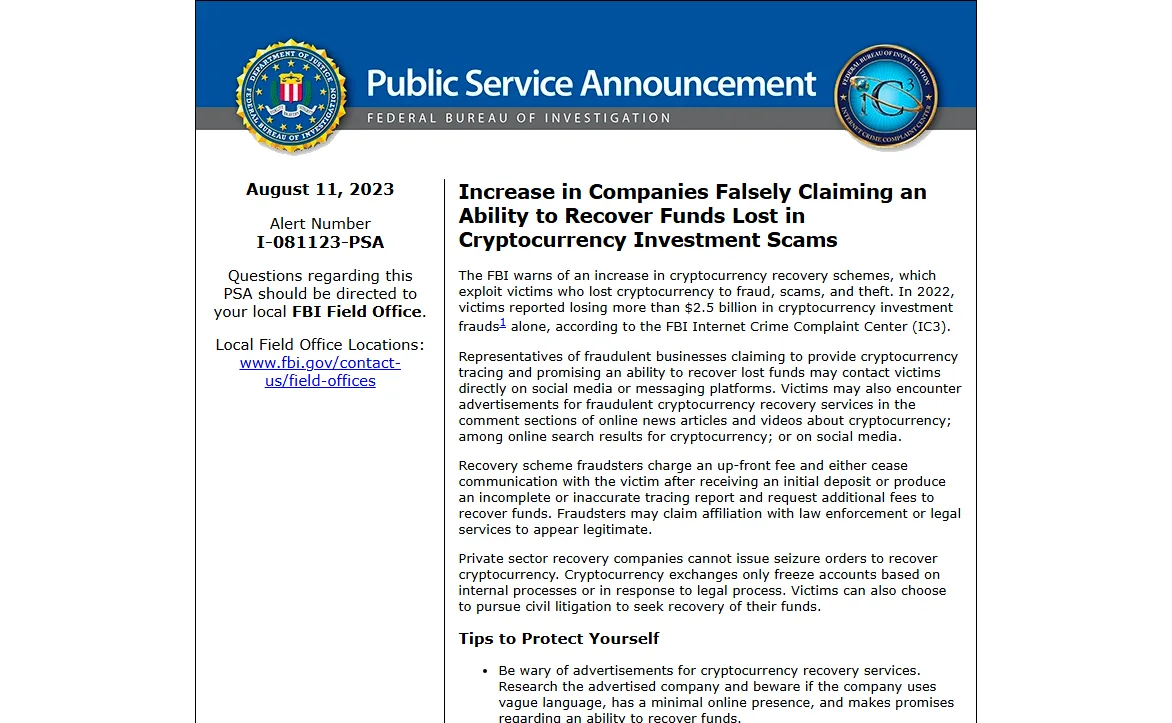
What matters is the next step. Knowing a receiving address does not give a tracing company control over its funds. If the money reaches an exchange, the exchange may freeze the account through its own internal procedures or in response to legal process. A private recovery company cannot issue a seizure order. IC3 explains that distinction here:
October 2026
The IC3 announcement distinguishes private tracing services from legal powers to seize assets. It also says victims can pursue civil litigation. A tracing report is not a substitute for reporting the scam to law enforcement.
When you do report, list each transfer's transaction hash, the receiving address and the time, and hand that to the police. All of it is already public on the blockchain. You don't need to buy a "tracing report" first.
Someone claiming to be police, the FBI or "Interpol" gets in touch: how to check
Wuxi police published a case from November 2023. A woman who had lost money to a fake online task job searched the web and found an ad promising to "recover money scammed within 24 hours." She added someone on QQ, a Chinese messaging app, who said he was a police officer and promised to get the money back. She gave him her bank card number and entered a code as he instructed. By the time she realized, she had lost 182,746 yuan.
Two things in that story should never happen: giving a stranger your card number, and typing in a code because they told you to. Real reporting goes through official channels you look up yourself, never a contact listed in an ad.
Checking is not complicated. The key is that you find the number; you don't use one they give you.
- In the United States: IC3 advises that if someone claims an affiliation with the FBI, you contact your local FBI field office to confirm. The same notice repeats that law enforcement does not charge victims to investigate.
- In mainland China: whatever department they claim to be from, hang up and call 110 yourself, or go to the nearest police station. Wuxi police state that anyone claiming to be cyber police, a hacker or a rights-protection expert able to recover your losses is a scammer.
- Anywhere else: apply the FTC's warning to unexpected recovery contacts who demand payment or personal information. Find your local police's reporting channel through an official government site, not a search ad. Verify any claimed authority there before sending anything.
Stop an unexpected recovery contact when you hear these
- "We need a retainer, deposit or tax payment before we can start."
- "Full recovery guaranteed," or "this window closes today."
- "Send your card number and the verification code so we can confirm the refund account."
- "Fees are payable in USDT only," or a transfer to someone's personal account.
- "We received your case file from the police / the FBI."
The FTC lists the payment methods recovery scammers insist on: cash, gift cards, cryptocurrency, wire transfers and payment apps. It also notes that legitimate helpers won't ask for your financial account numbers or guarantee you'll get money back.
Already paid a "recovery service"? What to do next
- Stop at this payment. In the pattern IC3 describes, the first fee is followed by "the report is ready, there's one more charge." Paying the next one won't bring back the last.
- If you shared a card number or a code, or let them guide you through online banking, call your bank now on the number printed on the back of your card and explain what happened. The FTC's advice to people who've already paid is to act quickly.
- Report both scams together. Bring the transfer records and chats from the original scam, plus everything from the "recovery" contact: names, phone numbers, websites or ad screenshots, receiving accounts and payment receipts. In the United States, file at ic3.gov and at ReportFraud.ftc.gov. In mainland China, call 110 or go to a police station.
- Treat the next offer the same way. Victim lists can be passed around, so more than one group may come knocking.
To pull your evidence together, work through the first 72 hours checklist. Someone offering to "unfreeze" your bank account for a fee is running the same structure; see bank account frozen? what to do first. If the original scam stalled at "pay before you can withdraw," start with told to pay a fee or tax before you can withdraw. Not sure which pattern their wording fits? Paste it into the script matcher.
Sources
- FBI Internet Crime Complaint Center: Increase in Companies Falsely Claiming an Ability to Recover Funds Lost in Cryptocurrency Investment Scams (2023-08-11; contact channels, up-front fees, tracing reports, seizure orders and exchange freezes)
- FBI Internet Crime Complaint Center: Fictitious Law Firms Targeting Cryptocurrency Scam Victims Offering to Recover Funds (2024-06-24; claimed links to the FBI and CFPB, fee structure, reported losses)
- Federal Trade Commission: Refund and Recovery Scams (page marked as updated December 2023)
- Wuxi Municipal Public Security Bureau (Chinese): Can they help you recover scammed money? Beware of being scammed twice (2023-11-29; the case, two recovery pitches and the police advice)
All four pages were read on 2026-10-14. The title of the Chinese-language page is our translation.